28th May - On marshy grassland to west of Bryn Tip, 4 Common Blue, 3 Small Heath & 1 Dingy Skipper. Then along track to north, more Common Blue, Small Heath & my first Small Copper this year. On tip itself, despite the stiff breeze, 21 Common Blue (two female) and 12 Small Heath. No frits this year, but probably too early yet.
2nd June: At Seven Sisters, I counted 21 very fresh Marsh Fritillary in 5 mins, before sun went in, in a sheltered hollow south of access track. Only 1 fresh male Marsh Fritillary was seen flying across burnt & damaged area, north of access track. There were numerous Small Heath and a couple of Burnet Companion also fresh on wing.
2nd June: At Rhos Common, Crynant, I found 1 fresh Marsh Fritillary today, after walking across most of southern part of common. Like many sites this year, nectar sources were scarce and this individual stayed around a small group of Heath Spotted-orchid flowers.
Funny year in many ways as vegetation still mostly very late (e,g. not even buds on Meadow Thistle yet) but many butterflies emerging normal time, then finding little nectar sources, particularly on burnt areas of Purple Moor-grass.

04 June 2010

Otter at Blue Pool
Richard Wilson reported that a friend of his was surfing at Blue Pool, Broughton early yesterady morning around 6am and watched an Otter playing in the sea. Otters are occasionally spotted around the coast of west Gower in summer so always worth keeping an eye open, especially if you're out and about early in the morning.
02 June 2010
Weaver Fish WARNING
Sian Musgrave from the National Trust reported to me the following: 'We are getting news of a lot of weaver fish stings already this year at Llangennith ... the best advice is to wear flipflops/trainers and to avoid the water at low tide. Stings are typically on feet, hands and buttocks and the treatment is soak in water as hot as you can stand, with vinegar, for 10 - 20 mins (depending on how long ago you were stung), and whatever you do, despite the intense pain, dont panic!'
Having never seen a Weaver Fish myself, I now know how I might get the chance to experience one at least!
Here's a link to a pic of this grumpy-looking fish http://animalpicturesarchive.com/animal/a5/MKramer-Pieterman-Weaver_Fish-with_Scallop-and-Marine_Roundworm.jpg
Having never seen a Weaver Fish myself, I now know how I might get the chance to experience one at least!
Here's a link to a pic of this grumpy-looking fish http://animalpicturesarchive.com/animal/a5/MKramer-Pieterman-Weaver_Fish-with_Scallop-and-Marine_Roundworm.jpg

Various observations
Mark Newton http://www.welshwildlife.com/ took the following images in the last few days from various sites:


The Fen Raft Spider (Dolomedes plantarius) is one of Europe's largest, most beautiful but least common species of spider. In our area it is found on the Tennant Canal, accessible from Pant-y-sais Fen LNR, though requires careful stalking along the canal tow path if you are to see it.
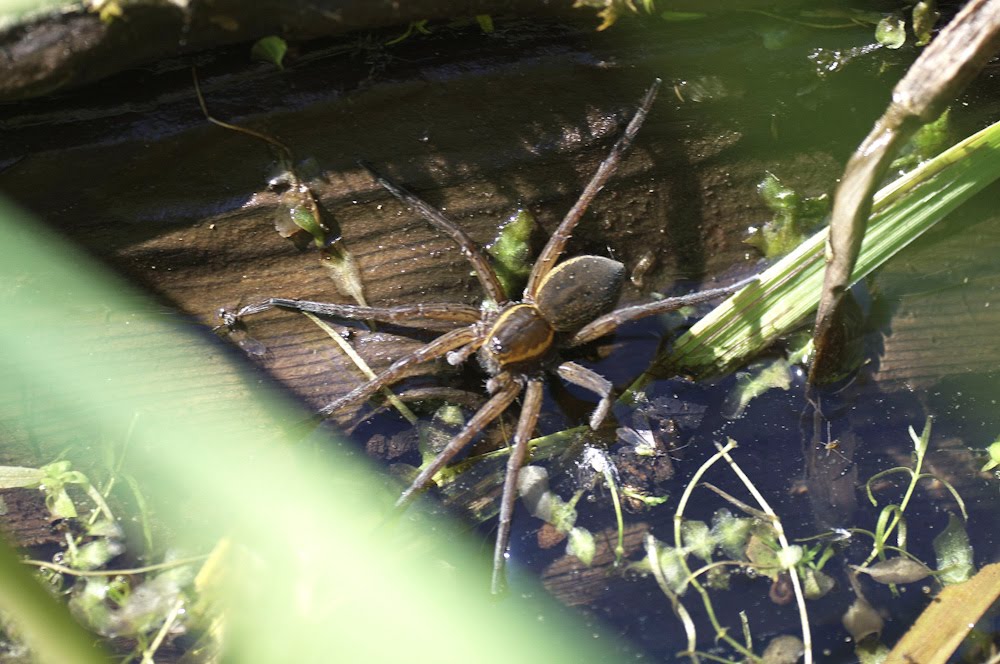
For more information on this species check out http://www.dolomedes.org.uk/index.html
Common Blues are now out in reasonable numbers, but keep an eye open for Brown Argus which can often appear in the same localities, especially near the coast. This one was photographed at Felindre.

Also seen at Felindre was this Lesser Whitethroat; like the Fen Raft Spider, this usually requires a bit of patince to get an unobstructed view like this.

The Kittiwakes are now with eggs on Mumbles Pier. Not sure of the numbers at present, but there have been over 100 pairs in recent years.

01 June 2010
Rosy Garlic at Crawley Bluff
Nick Edwards photographed this Rosy Garlic (Allium roseum) at Crawley last week. It was first recorded in our area in 2007 when a couple of plants were noted at both at Crawley Bluff and Port Eynon dunes. It is clearly a very recent colonist, and although an alien, is an attractive addition to our flora.

Nearby Nick also saw Brown Hare, a very notable species these days in Gower!

Profusion of marsh-orchids at Whiteford
The new slack at the south-western corner of Whiteford NNR has developed over the last 10 years of so and the flora in there diversifies year-on-year. Although there are perhaps more notable sedges and rushes, the stars of the show yesterday were undoubtedly the drifts of Southern and Early Marsh-orchids (Dactylorhiza praetermissa and D. incarnata subsp. coccinea).
Southern Marsh-orchids genrally outnumbered Early Marsh-orchids by about 4:1
a.jpg)
The pink form of Early Marsh-orchid is frequent throughout the slack with some good displays by the track along the eastern edge.
a.jpg)
[NB. If you do visit this site please be respectful of the breeding birds as there are several pairs of Lapwings and Ringed Plovers with chicks.]
Sea-heath at Three Cliffs Bay
a.jpg)
Yesterday I went to see if I could find the small 9 inch patch of Sea-heath (Frankenia laevis) reported by P.G. Garner in 2002. I was amazed to discover the plant has proliferated since then and is now abundant along the shoreline at the back end of the bay. I counted some 122 plants, including some amalgamated into mats >2m across, though most were less than <30cm. This is a recent colonist in Gower, though another healthy population was also discovered by Charles and Hilary Hipkin in similar habitat at Crymlyn Burrows. How it's arrived at these isolated sites is a mystery to me?
A carpet of Sea-heath along the strandline with Pennard Castle behind. The woodland on the left has some good specimens of Small-leaved Lime, with its upward-turned flowers.
a.jpg)
Subscribe to:
Posts (Atom)