
Showing posts with label Gorseinon. Show all posts
Showing posts with label Gorseinon. Show all posts
14 September 2012
House Cricket singing in Gorseinon
At 22:30 just as I was jumping in the car I was amazed to hear a House Cricket singing in the front garden. The temperature according to the car was 12.C. 15 minutes later when I returned the temperature had dropped a couple of degrees and the singing had stopped, but another check 5 minutes later and it was singing once more albeit just for less than a minute. A quick check on line confirmed the song was House Cricket (Acheta domesticus) rather than Tropical House Cricket (Gryllodes sigillatus). Hopefully it will be singing again tomorrow and I'll get a recording...
Has anyone else heard House Crickets - I suspect keepers of spiders and reptiles are probably the source of our cricket?

02 September 2012
Leiobunum blackwalli in Gorseinon
.jpg)

13 August 2012
Two new moths for Gorseinon
Although insect numbers have been significantly down during 2012, the garden moth trap produced 84 species over the last two nights, proving that there are still reasonable numbers of moths out there. Despite 17 years of trapping we do still encounter the odd new species for the garden and on Sunday morning Glamorgan and possibly Wales' first Cydia amplana was in the trap. This tortrix moth is a scarce migrant that has been appearing in small numbers along the south coast in recent days. Small Argent & Sable, a heathland species so presumably a wanderer, was another addition to the garden list this morning.
.jpg) |
| Small Argent & Sable |
.jpg) |
| Cydia amplana |
16 June 2012
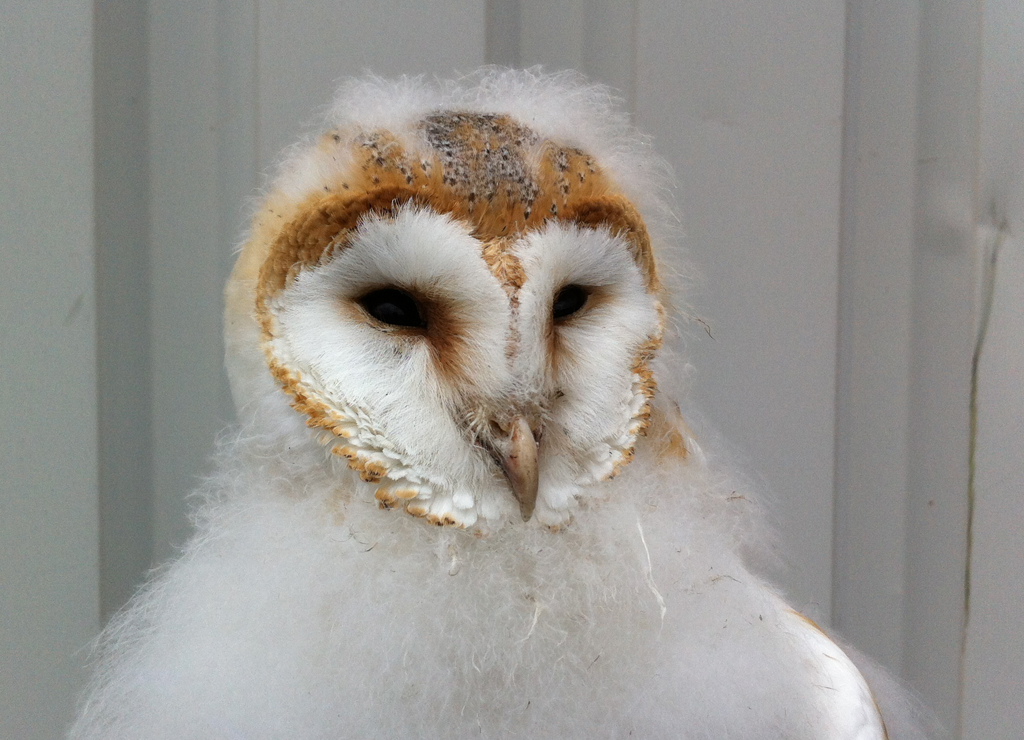
Barn Owls in Gorseinon
08 June 2012
Busy Tree Bees
I was quite surprised to see up to 7 Tree Bumblebees (Bombus hypnorum) busy on the Wall Cotoneaster (C. horizontalis) outside the kitchen window yesterday, despite the persistent rain. They were coming and going all the time so there's clearly a nest nearby. The only other species noted braving the weather were a couple of Early Bumblebees (B. pratorum). Today's weather is much more extreme, with gales as well as driving rain, so it will be interesting to see how hardy these newcomers really are!...
26 February 2010
Great haircut!
Despite the milder conditions, just a single moth in the trap last night, this only our second garden record of Pale Brindled Beauty here in Gorseinon (though we tend not to set the trap too often in February). The females of this reasonably common wodland species are wingless.
a.jpg)
a.jpg)
25 February 2010
Frog watch...
a.jpg)
Despite the gloomy conditions I couldn't resist taking a few more shots of these fabulous creatures. The attached map shows all records of Common Frog that are on the MapMate database (not that many!), with 2010 records highlighted red. If you have breeding frogs in your garden or see them elsewhere, I'll add them to the map if you let me know (date, postcode or a grid ref will do, though an estimate of spawn clumps will be useful to know).

At last it's time to spawn...
The first sign of milder weather and they're at it! When I went to feed the garden birds this morning there was a mass of frogs diving for cover and I found 5 freshly deposited clumps of spawn in the pond. I'd be interested to know when others have seen or see their first spawn of the year?


19 February 2010
Early Bumble-bees
In response to Nigel's comments on an earlier thread (http://goweros.blogspot.com/2010/02/velvet-scoter-off-crymlyn-burrows-beach.html), I saw my first Buff-tailed Bumble-bee (Bombus terrestris) queen of the year on 16th Feb at Parc-y-Werin, Gorseinon. I'll certainly be keeping an eye open in the race to spot the first Bombus hypnorum for the west of the county! Excellent photos of this distinctive species can be seen at http://www.flickr.com/photos/tristanba/3511293282/ though I guess it's not one of the earlier species to emerge?
Thanks for the link to NHM website - this looks very useful.
http://www.nhm.ac.uk/research-curation/research/projects/bombus/
Thanks for the link to NHM website - this looks very useful.
http://www.nhm.ac.uk/research-curation/research/projects/bombus/
06 January 2010
More garden feeder action

A Brambling from the kitchen window (in Gorseinon) brightened things up a bit this afternoon and there was another seen on feeders at Newton, Mumbles today.
03 January 2010
Unseasonal visitor!
a.jpg)
a.jpg)
This Turtle Dove was first noted by Ken and Angela Wade in their Gorseinon garden on Jan 1st and after a four-hour wait it eventually reappeared at their feeding station on the 2nd. Quite a remarkable record of a bird that should be spending the winter in Africa! It appeared to be in good health and with the bountiful supply of food should have no problem surviving the harsh weather, so long as it remains wary and avoids the local cats. Ken reported that the bird was present again today and that it came down to feed on at least two occasions.
In addition to the dove we collectively recorded 23 species in Ken & Angela's garden yesterday including Redwing, Fieldfare, Nuthatch, 4 Greenfinches (now very scarce in Gorseinon) and 7 stunning Bullfinches at very close range. Sandra, Neil and myself are most grateful for our near neighbour's hospitality and conversation.
Interestingly our own garden is less than 100m away and we have not seen a Nuthatch, Greenfinch or Bullfinch all winter, however, we are hoping the dove may wander a little before it eventually moves on!
PS. Reading Birds in Wales (Lovegrove et al, 1994) I was interested to discover that this is not the first time Turtle Dove has overwintered in Wales; there was a bird at Pilton on the Gower peninsula from 13th to 20th February 1977.
24 December 2009
Ectoedemia septembrella leaf mine

The leaf mine of the Nepticulid moth Ectoedemia septembrella occurs on Hypericum species including Rose-of-Sharon (H. calycinum) and other ornamental species. It was first recorded in Glamorgan in Cardiff as recently as 2004 and is now well-established there. It was first found in Swansea in 2006 by Martin White in Swansea Marina and a thin scatter of subsequent records indicate that it is now probably widespread in urban situations around the city. The above photo was taken in Gorseinon today. Please report if you see this recent colonist...
19 December 2009
Reed Bunting in Gorseinon garden

A female Reed Bunting below the feeders was a new species for the garden today, no doubt displaced from its regular haunts by the hard freeze.
15 October 2009
Shaggy Soldier in Gorseinon
+09oct09+(4)a.jpg)
+09oct09+(3)a.jpg)
I first noted this bird seed alien growing in the gutter of Pencaecrwn Road, Gorseinon in 2003. It has reappeared in the same spot every year since and seems well-and-truely naturalised in this niche! There are other surprises amongst Gorseinon's 'pavement flora', perhaps the most usual noted to date being Marsh Arrowgrass (Troglochin palustre) found growing in association with Jointed Rush (Juncus articulatus) in a gutter kept permamnently wet by a leak.
09 October 2009
Honey Fungus in Gorseinon

Honey Fungus (Armillaria mellea) is one of the most feared of garden pests and it’s been in our garden since for at least three years, with noticeable dieback of part of our privet hedge. The RHS states 'There are no chemicals available for control of honey fungus. If honey fungus is confirmed, the only effective remedy is to excavate and destroy, by burning or landfill, all of the infected root and stump material'. However Nigel Stringer did tell me of an old wives tale, that by spreading flour over the affected area it encourages another fungus (species unknown to Nigel) which will suppress and eventually kill off the Honey Fungus. I did treat the affected area last year and less has appeared so far this year, but time will tell!
Note that this is a good time of year to look for waxcaps on garden lawns which can be surprisingly good for this group...
30 September 2009
Blair's Shoulder-knot in Gorseinon

Blair's Shoulder-knot appeared in the garden trap for the first time this year on the 15th October, the one shown above being trapped on the 30th. The caterpillars of this suburban moth feed on various cypress including Leyland Cypress and it is now widespread in parks and gardens throughout the area. The species is a fairly recent colonist the first record for West Glamorgan being 12th October 1995, some 19 years after it first appeared in the eastern half of the county at St Mary Church.
21 September 2009
Vine Weevil in Gorseinon moth trap

Weevils are only occasionally attracted to light and Vine Weevil (Otiorhynchus sulcatus) has now appeared twice in the garden moth trap this month. For more weevil photos from West Glamorgan check out: http://www.flickr.com/photos/moonmoths/3959564253/in/set-72157618069878515/ All specimens have been identified from photographs by Adrian Fowles.
12 June 2009
Lime Hawk-moth Gorseinon
+1a+12jun09.jpg)
Lime Hawk-moth in the garden trap. This species now appears to be reasonably well-established in West Glamorgan, though is still uncommon.
Subscribe to:
Posts (Atom)