
16 February 2013
Asteroid 2012DA14
Sandra's close scrutiny of some images taken last night eventually revealed a rather over-hyped astronomical display by this near-Earth object!
Not quite Star Wars, this video flicks between two 30 second exposures, one minute apart, as the asteroid passed through the constellation of Ursa Major. This amazing experience was shared with the Minopoli family.

15 February 2013
Otters, Lutra lutra - Rhossili Bay

My son, Gwyn Thomas reported that at 21.00 last night, 14th Feb, 2013, he observed three otters (judged to be a female with two well-grown cubs) in the sea off Kitchen Corner, Rhossili Bay.
The map ref: SS 40277 87609 for the location.
Kitchen Corner is the farthest south-west point of the Rhossili Bay cliffs, just before the Causeway on the left, looking out to sea.
These were making their way from the causeway (Crabart) towards the bay, at a distance of around 10 metres out from the rocks.
Sadly the light was too poor for his camera-phone to record an image, though they were well illuminated by his headlamp.
They were uttering squeaking contact calls to each other, with which Gwyn is familiar, and he has no doubt of the identification.
He reports that many dabs were about that night, and he thinks the otters were targeting them.
Certainly they are partial to sea fish - this is one eating a sea lamprey on the river Teme at Ludlow-

And they are common in the seas off the Western Isles, but I have had no experience of these in the seas of Gower. Are there any other reports of these?
I should welcome comments on this sighting.
Evergreens close-up
.jpg)
Clusters of pollen cones on several pine species are now also beginning to swell, as with this Monterey Pine (Pinus radiata) growing on the roadside at Heron's Way.

Note the clean, adpressed scales of the bud topping the male cones of the Monterey Pine [top image below], compared with the recurved and ciliate bud scales of a Maritime Pine (P. pinaster) growing roadside in Penclawdd, Stone Pine (P. pinea) at Mewslade and the resinous papery scales of an Austrian Pine (P. nigra subsp. nigra) growing in Gorseinon.
 |
| Monterey Pine bud (leaves in clusters of 3) |
 |
| Maritime Pine bud (very long leaves in pairs) |
.jpg) |
| Stone Pine (closely related to Maritime Pine, but structurally very different, leaves darker, cones very blunt) |
.jpg) |
| Austrian Pine bud (leaves in pairs, buds with resinous papery scales) |
10 February 2013
Squeezing iron out of a stone
Iron is the second most abundant metal on Earth (next to
aluminium). About 3000 years ago human
beings figured out how to extract it from rock, a skill that catapulted mankind
into an era of self-determination and dominion over nature. Yet some crustose lichens,
which grow on and in stone, have been doing this quietly for millions of years.
Take a walk along forestry tracks into the hills in any of the valleys in Neath
Port Talbot and look out for rusty-red stained rocks colonised by these amazing organisms. Two species, in particular, should draw your attention.
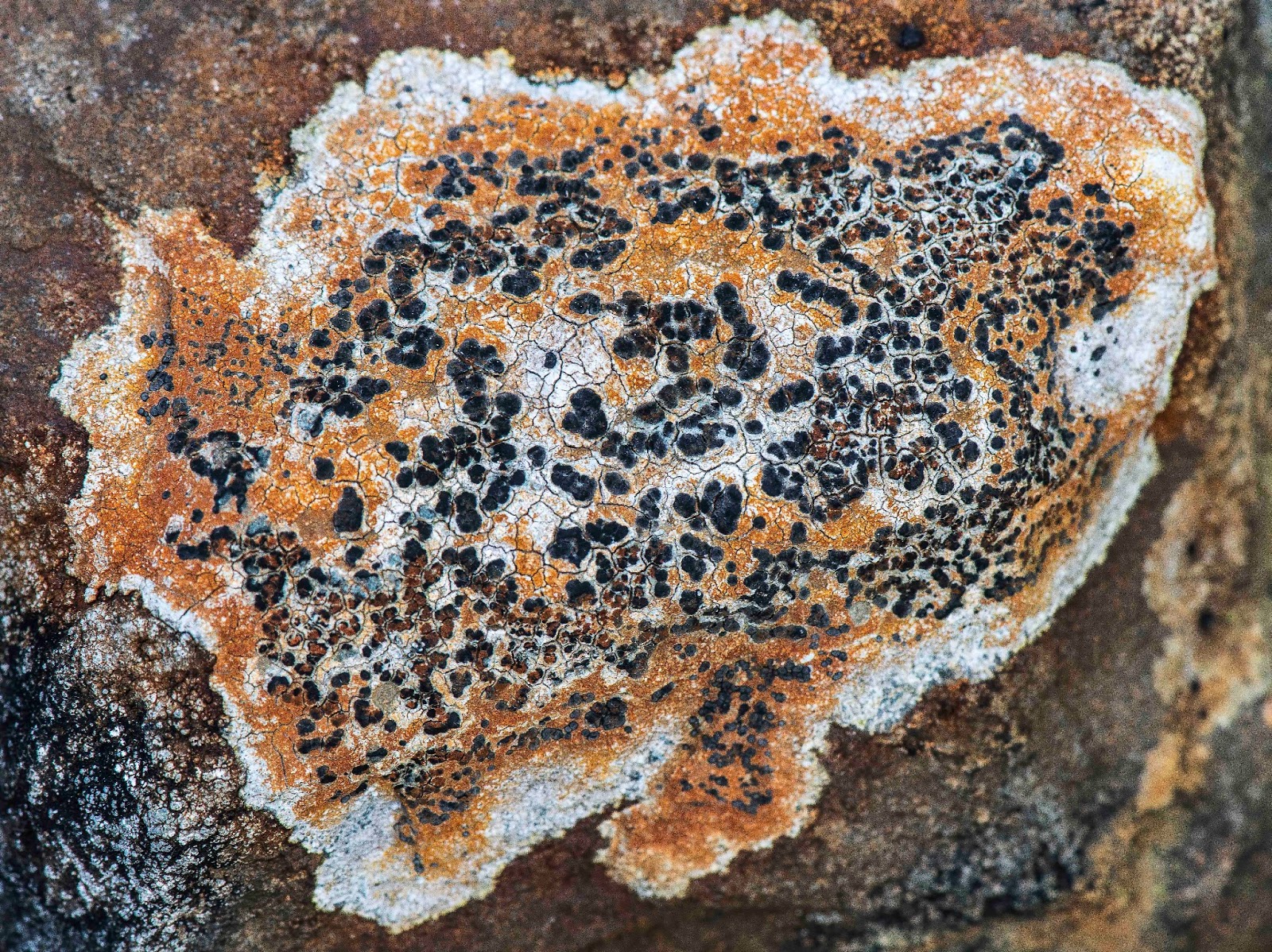
Lecidia lithophila (above) is a fairly common upland lichen able to extract iron from rock, which results
in an attractive stone mosaic with characteristic rusty staining that is
difficult to miss. The black pimples are apothecia, spore producing structures formed
by the fungal part of the lichen.

Porpidia macrocarpa (above)
can also do this, often with much greater effect so that the whole of the
surface of the stone can become rusty-red in colour. Note the very large black
apothecia (up to 3mm in diameter) which are a characteristic of this species.
While an ability to make a living growing on rock has to be
admired, extracting iron out of stone is something else!
09 February 2013
An adaptable epiphyte
.jpg) |
| Lesser Yoke-moss growing on an Ash trunk at Cwmgwarch showing the curved setae (fruit stalks) which are a key id feature. |
Lesser Yoke-moss (Zygodon conoideus) is a frequent epiphyte on trees in our area, an epiphyte being a plant that grows on another plant, using it only for mechanical support, and unlike parasitic plants does not derive any nutrient from the host plant. So what about a plant that grows on a steel pipe? Blueish Veilwort (Metzgeria violacea) is clearly a resourceful epiphytic liverwort and is seen here growing 'epi-pipe-ically' below a bridge in Crynant. Only one aspect of the painted pipe appears to provide the right conditions, but here the plant is able to flourish on this unusual habitat. The close up image shows the distinctive thin branches bearing pom-pom tips, in fact made up of clusters of gemmae (asexual reproductive propagules).
+19sep12+(6a).jpg)
+19sep12+(1a).jpg) |
| Blueish Veilwort |
Whiskered Veilwort (Metzgeria consanguinea) is closely related to Blueish Veilwort and is shown here growing epiphytically on the stems of Gorse at Cwmgwrach. A key feature separating it from Blueish Veilwort is that the gemmae don't form pom-pom tips at the branch tips, but are spread along the edges of the thin branches.
+01feb13+(3a).jpg) |
| Whiskered Veilwort |
Buzzard worrying
Not much news from Alveley (Rhossili) this week; just our resident Buzzard being continually mobbed by the local Carrion Crows. These pics were on two separate days, and they rarely left the Buzzard alone to get on with its regular mousing and worming. The male crow is nearly the size of a Raven, with a beak to match.
They are surprisingly aggressive so far out of the breeding season. Buzzards soon learn to live their whole lives under continuous mobbing from one source or another.


They are surprisingly aggressive so far out of the breeding season. Buzzards soon learn to live their whole lives under continuous mobbing from one source or another.


04 February 2013
Rhossili shellfish strandings
 |
| Otter Shells (Lutraria lutraria) |
 |
| Pod Razors (Pharus legumen) |
 |
| presumably Sand Mason Worms (Lanice conchilega) |
Subscribe to:
Posts (Atom)