29 April 2013

Yellow Whitlowgrass 2013 survey

Karen Wilkinson (Natural Resources Wales) wrote:
'Early in April Mervyn Howells, myself and a handful of other volunteers undertook a survey of Draba aizoides (Yellow Whitlowgrass) of the south Gower Coast. Gower is the only known UK location for this species in the UK, although it is also found in the mountain ranges across Europe such as the Alps, the Pyrenees, the Carpathians and the Jura mountains. It grows in cushions in crevices and on ledges along the Carboniferous Limestone from Pwll Du in the east to Tear’s Point in the west. As it is an early flowering species, its yellow flowers are particularly distinctive at this time of year before most other species are in flower.
Mervyn has been monitoring the populations for more than 20 years and has an amazing knowledge of the distribution of plants which often occur in very precarious situations! Although it clearly has a limited distribution in the UK, in Gower it does appear to be stable; this year around 1400 plants were recorded. This is likely to be an underestimate as some locations are extremely difficult to survey safely, where we also noticed good numbers of plants growing in the grassland sward at the top and bottom of cliffs. This may be partly due to changes in grazing pressure or might be related to successful seed production or seed germination in recent years.
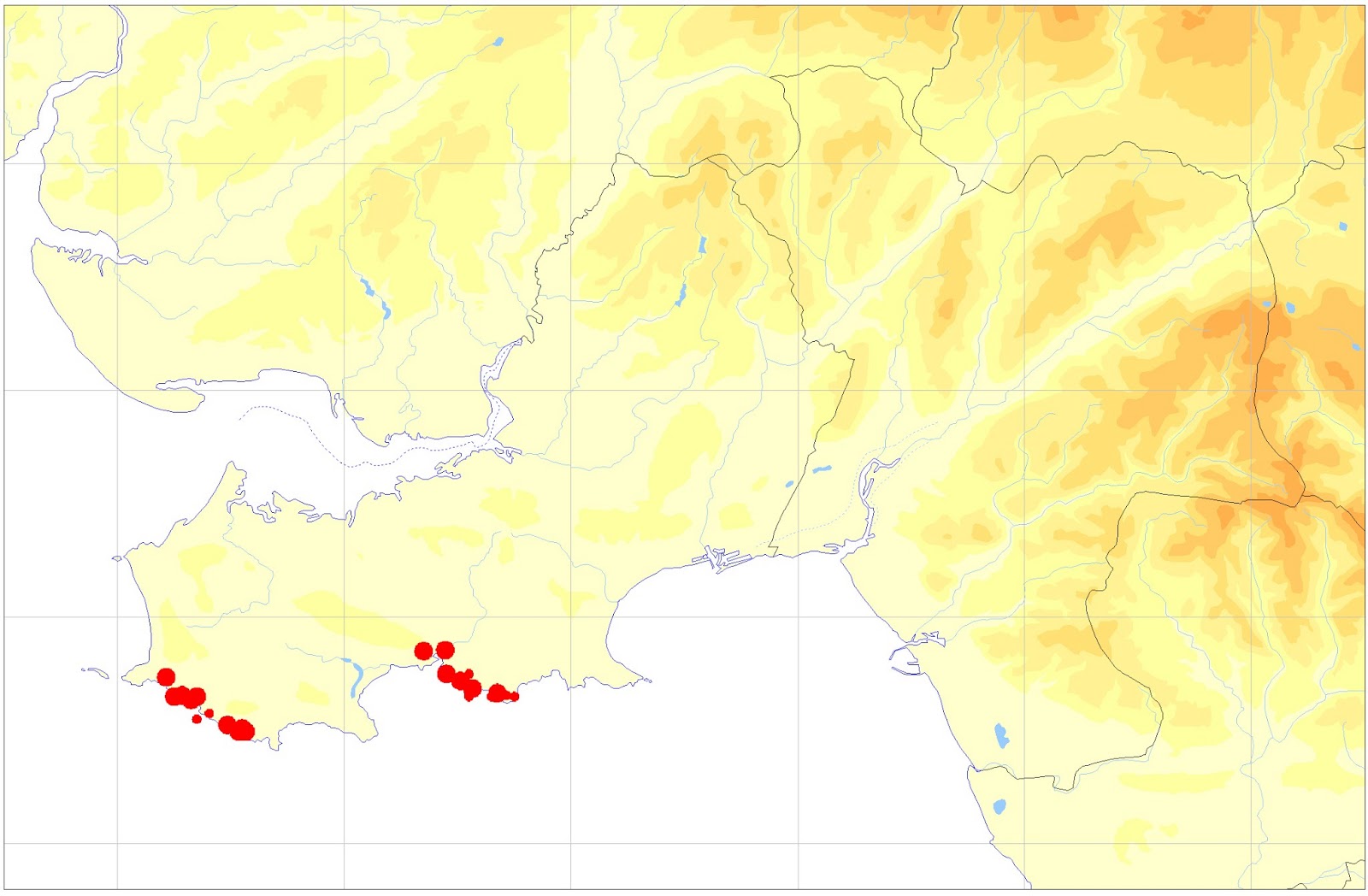
Distribution map of all pre-2013 records of Yellow Whitlowgrass
(results from 2013 show a very similar pattern)

During the survey we also noticed a larger population of Sedum album (White Stonecrop) than we were previously aware of, primarily along the thin band of therophytic vegetation on the cliff tops. This plant is frequent in the droughted slopes around Port Eynon and we are keen to keep an eye on its spread west and its effects on the local flora. If anyone has any new or historic records for this species we would be interested in hearing from you.'
Distribution map of all pre-2013 records of White Stonecrop
(pre-2000 records shown by smaller dots)

27 April 2013

Wild-type Daffodils in West Glamorgan

Rob Ladds was photographing the Wood Anenomes in Gelli-hir Wood last week when he came across a small drift of circa 50 Wild-type Daffodils (Narcissus pseudonarcissus subsp. pseudonarcissus) in an obscure and difficult to access part of the site. There are relatively few records of Wild-type Daffodils in West Glamorgan as can be seen below and whilst it is possible most if not all are deliberately introductions, some may be relict populations, although one might expect long-established natural populations to be much larger than this? Regardless of their true status, finding Wild-types in the 'wild' will always provide great pleasure. I wonder if genetic testing may one day reveal the true status of our plants in Gower?

24 April 2013

Spoonbills in the Burry

Spoonbills photographed at WWT Llanelli by Wendell Thomas. Quite bizarrely the immature bird arrived on the 7th April, this being the same day the adult departed!
adult present 20th March to 7th April 2013 (c) W. Thomas
note crest, yellow breast band and yellow-tipped black bill
immature present7th April yo present 2013 (c) W. Thomas
note dark tips to primaries and pinky bill

21 April 2013

Roadside Scurvygrass

The white 'fuzz' visible in the central reservation of motorways and other dual carriageways at this time of year is Danish Scurvygrass (Cochlearia danica). It thrives on the verges of these heavily salted roads as its adaptations for surviving in drought-prone soils within the spray-zone of coastal habitats enable it to tolerate the similarly harsh environment of the motorway central reservation.
In additional to the species' natural coastal preference, the distribution maps shows the close association with Glamorgan's major roads, namely the M4 and the southern part of the A465. No doubt it will continue to thrive so long as our roads are salted, but whether or not it has reached its maximum potential remains to be seen.
[Yesterday 30th April happened to drive a short section of the A470 and added a few more records - it will be interesting to see how far up this road it extends?]

20 April 2013

Arctic Terns : Loughor Bridge

Lucky to catch up with the few that were left late morning,the huge number that were there last Thursday must have been a fantastic sight.

19 April 2013

bees from near Pwll Du on 7th April

 Andrena minutula male seems to be pretty common everywhere. Covered in mites poor thing. 2 broods per year, male of first brood have black facial hairs, second brood have white, que!
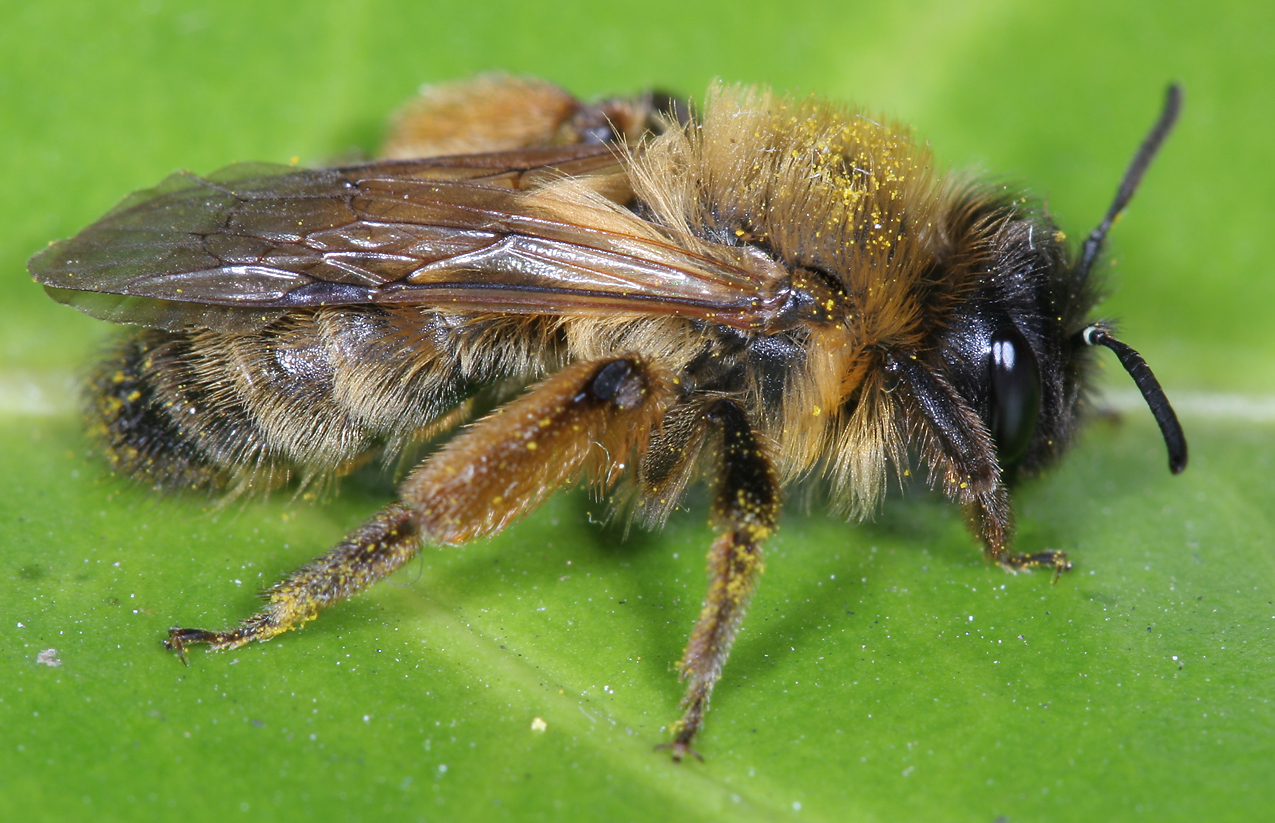
 Andrena trimmerana male, note the reddish colour under the front gastral segments. Again 2 broods, males of first brood have alarge spine at base of mandibles visible here but not in the second brood, que again!
 Osmia bicolor male, the female is half black and half red and really obvious and common on the cliffs and dune systems of the gower. Nests in empty snail shells.
and one from the university on 9th Andrena nigroaenea female.

Woodcock and Wales Chat Surveys 2013

The BTO are running a Woodcock Survey this year and repeating the Wales Chat Survey due to the bad weather last year.  If anyone would like to help out with either survey I have attached a link to the BTO website for further information, or you can contact me direct.

The recent Beached Bird Survey (this one is RSPB) was a great success with full coverage of the Gower beaches to be surveyed.  Only 2 birds were found, as well as one wing and some feathers, with no sign of oiling on the birds or beaches.  My thanks to everyone who helped out with this survey.

Alastair Flannagan
BTO Regional Representative
West Glamorgan